
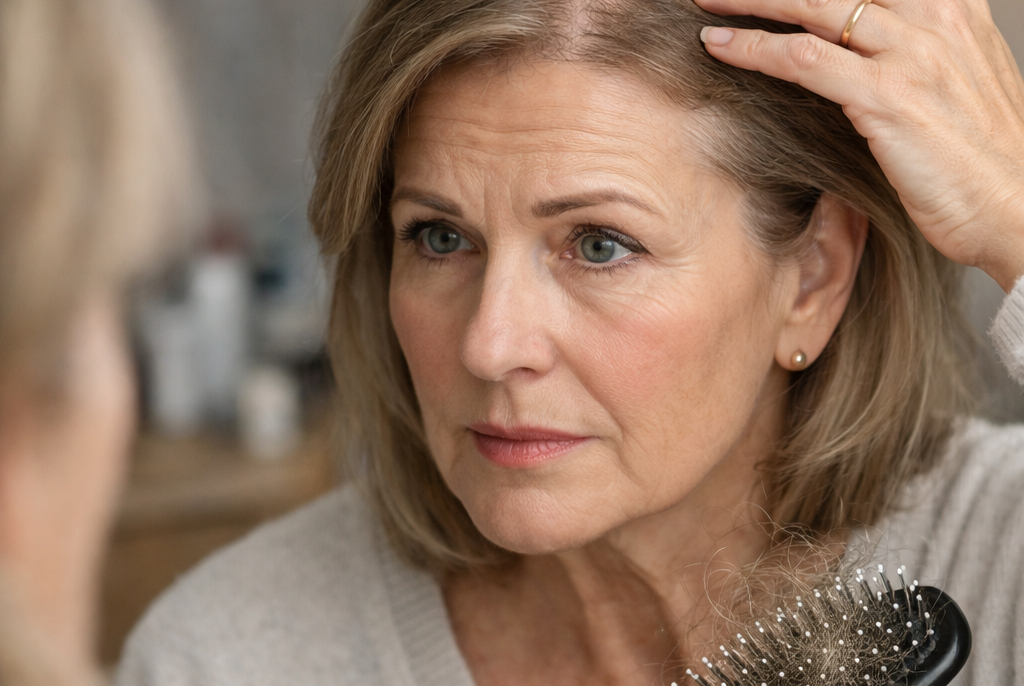

Hair loss as women age is one of the most distressing and least openly discussed physical changes of midlife. While society often frames hair thinning as a male issue, up to half of women experience noticeable hair loss by their 50s and 60s. For many, it feels deeply personal. Hair is tied to identity, femininity, and self-expression, so watching it thin, shed, or lose volume can affect confidence and body image in powerful ways.
The reassuring truth: age-related hair loss in women is common, biologically driven, and often treatable or improvable.
Why Hair Changes with Age
Hair growth occurs in cycles: growth (anagen), transition (catagen), and resting/shedding (telogen). With aging and hormonal shifts, several changes occur simultaneously.
1. Estrogen decline
Estrogen helps keep hair in the growth phase longer. As estrogen falls in menopause, more follicles shift into the resting/shedding phase. Hair becomes finer, grows more slowly, and sheds more easily.
2. Relative androgen effect
Even though absolute androgen levels also decline with age, the drop in estrogen creates a relative increase in androgen influence on hair follicles. In genetically susceptible women, this leads to follicle miniaturization the hallmark of female pattern hair loss.
3. Follicle aging
Hair follicles themselves age. The growth phase shortens, shaft diameter decreases, and regrowth after shedding becomes less robust.
4. Cumulative stress and health factors
Thyroid disease, iron deficiency, rapid weight loss, illness, medications, and chronic stress can all accelerate shedding, especially in midlife when resilience is lower.
Common Patterns of Female Hair Loss
Unlike men, who often develop receding hairlines or bald spots, women typically experience:
- Widening part line
- Diffuse crown thinning
- Reduced ponytail volume
- Increased shedding during washing or brushing
The frontal hairline is usually preserved.
What Helps: Evidence-Based Options
Hair loss treatment works best when started early and continued consistently.
Topical minoxidil (2% or 5%)
First-line therapy for female pattern hair loss. It prolongs the growth phase and enlarges miniaturized follicles. Shedding may increase briefly at initiation a sign follicles are re-entering growth.
Low-dose oral minoxidil
Increasingly used off-label in women who cannot tolerate topical forms or need stronger effect. Requires medical supervision.
Anti-androgen therapy
Medications such as spironolactone reduce androgen effect on follicles and can slow thinning in hormonally sensitive hair loss.
Nutritional optimization
Check and correct ferritin (iron stores), vitamin D, B12, zinc, and protein intake. Hair is metabolically “non-essential,” so deficiencies show there early.
Hormone therapy
Menopausal hormone therapy may modestly improve hair quality in some women, though it is not a primary hair loss treatment.
Scalp health
Inflammation from seborrheic dermatitis or psoriasis can worsen shedding. Treating scalp conditions supports growth.
Low-level laser therapy
Devices such as laser caps or combs show modest evidence for stimulating follicles with consistent use.
What to Expect
Hair regrowth is slow. Follicles cycle over months, so visible improvement typically takes 3–6 months, with maximal change by 12 months. The goal is usually thickening and stabilization rather than full restoration of youthful density.
The Emotional Side
Hair thinning often lands during a life stage already rich in change menopause, aging, shifting roles, and identity recalibration. Grief, frustration, and self-consciousness are normal responses. Many women quietly adjust hairstyles, avoid certain lighting, or change grooming routines long before they mention it aloud.
But hair loss does not define aging. It is a biologic process influenced by hormones, genetics, and time not a personal failing.
With early treatment, realistic expectations, and supportive care, many women maintain satisfying hair density and appearance well into later life. And importantly, the conversation around women’s hair loss is finally becoming visible which means fewer women have to navigate it alone.
Spread the word